
Pugs and the Renaissance portrait tradition
The pug has ancient royal connections — they were the favoured dogs of the House of Orange in the Netherlands, the companions of William III, the dogs of several European royal houses. They have been in proximity to nobility and the trappings of power for centuries. A Renaissance portrait, with its formal costume, its air of grave importance, its sense that the subject is someone who matters — captures something true about the pug that is both very funny and completely accurate. See the full Renaissance pet portrait collection for more on the style — or to see other breeds who were also destined for the throne.
A pug in a Renaissance portrait looks like a Roman emperor who has been slightly downsized. The wrinkled brow, which manages to suggest both deep philosophical thought and mild digestive discomfort, looks entirely at home above a ruff collar. The compressed muzzle, framed in elaborate lace, takes on a quality of imperious distinction. The wide-set eyes, which normally convey the pug's characteristic expression of vaguely affronted wisdom, look in the Renaissance setting like the eyes of someone who has governed a province and found it trying.
What the Renaissance style does for a pug
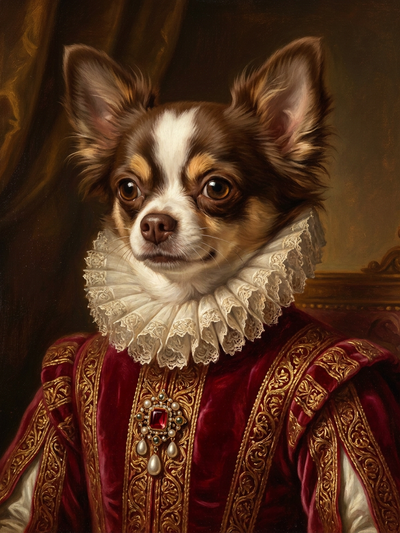
The Renaissance portrait tradition involves formal costume, rich colours, dark backgrounds, and warm raking light — all of which suit the pug's distinctive features extraordinarily well. The ruff collar frames the face in a way that somehow looks natural on a pug — the circularity of the collar matching the roundness of the face. The dark background throws the face forward, emphasising the wrinkles and the expression. The warm side-lighting catches the facial folds in a way that gives the portrait real sculptural quality.
The costume colours are selected to complement the pug's coat — warm purples and burgundies for fawn pugs, deep greens and blues for black pugs. The effect is a portrait that looks both historically accurate and completely absurd, which is exactly the right register for a pug.
Fawn and black pugs in renaissance style
Fawn pugs produce the warmest renaissance results — the honey-fawn coat against the dark background creates a portrait of real luminosity. The black muzzle and ear marking, in the warm raking light of the renaissance setting, becomes a feature of distinction rather than just a characteristic marking. The eyes — often amber or dark hazel in fawn pugs — glow with warmth in the glazed oil medium.
Black pugs produce perhaps the most dramatic renaissance portraits — the deep black coat against the dark background creates an almost monochromatic effect broken only by the warm highlights catching the upper surfaces of the coat and the costume. Black pugs in renaissance portraits have a quality of mysterious distinction that is genuinely striking.
The best gift for a pug owner
Pug owners know their dogs are special. They also know their dogs are slightly ridiculous. A renaissance portrait is the gift that acknowledges both — it takes the pug's self-assessment completely seriously while producing something that makes everyone who sees it smile before looking more carefully and realising it's actually beautiful.
Digital from $13 $10. Framed from $63 $51. Free worldwide shipping.