
The Italian Greyhound has been a companion dog of the aristocracy and royalty for over two thousand years. They appear in the art of ancient Greece and Rome, in Renaissance paintings by Pisanello, in portraits of Frederick II of Prussia and in photographs of Queen Victoria. The breed's combination of extreme physical delicacy — the fine-boned legs, the narrow head, the skin-close coat — with a personality of surprising intensity and affection has made them a consistent presence in the courts and households of those who value refinement. A portrait of an Italian Greyhound is, in the most literal sense, the continuation of a tradition that has existed for two millennia.
Coat and colour
Italian Greyhounds come in a wide range of colours — grey, slate grey, red fawn, fawn, cream, blue, black and various patterns with white. The coat is always very short, fine and glossy — the closest of any dog to skin, showing every line of the fine-boned body.
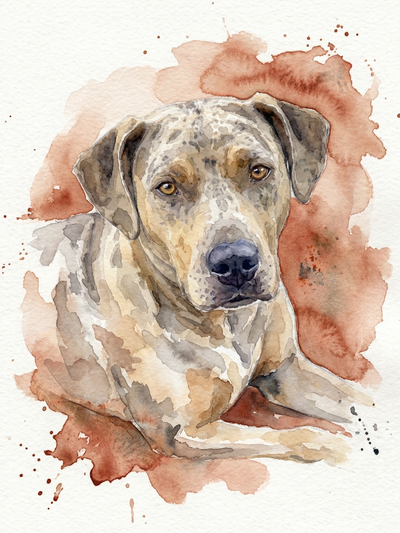
Grey Italian Greyhounds — the most classic and most common colour — produce watercolour results of extraordinary atmospheric delicacy. The cool grey coat in the loose washes of watercolour has a luminous, almost ethereal quality that suits the breed's physical fragility and elegance.
Red fawn and fawn Italian Greyhounds have warm, vivid coats that suit oil painting and impressionist styles. The warmth of the colour in the painting tradition creates portraits of great energy for such a small and delicate breed.
Blue Italian Greyhounds — the cool dilute — suit watercolour and impressionist styles with the same atmospheric cool quality as other blue-toned breeds.
Black Italian Greyhounds produce the most dramatic formal results — the glossy, skin-close black coat in Old Masters and oil painting creating portraits of extraordinary elegance.
Recommended styles for the Italian Greyhound
Watercolour is the most atmospheric and delicate choice for grey and blue Italian Greyhounds. Oil painting is particularly beautiful for red fawn and black Italian Greyhounds. Renaissance — the breed has been in Renaissance paintings for five hundred years and the connection is genuine. Pastel is the softest style for the most delicate breed. La Dolce Vita — the breed's Italian associations and the style's Italian setting create an obvious and beautiful combination.
Photo tips
The fine-boned body structure is as defining as the face in an Italian Greyhound portrait — a photo that includes the full body, or at least the head, neck and chest, captures the breed's extraordinary physical delicacy more completely than a face-only shot. The skin-close coat shows every line of the body and benefits from natural side light that picks out the muscle and bone structure. The narrow, elegant head should be shown at eye level. The Italian Greyhound's characteristic pose — often curled tightly or stretching full length — can make full-body portraits challenging but the breed's elegance in any position is worth capturing.