
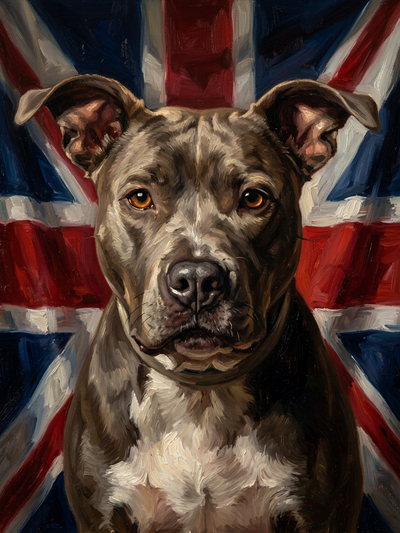
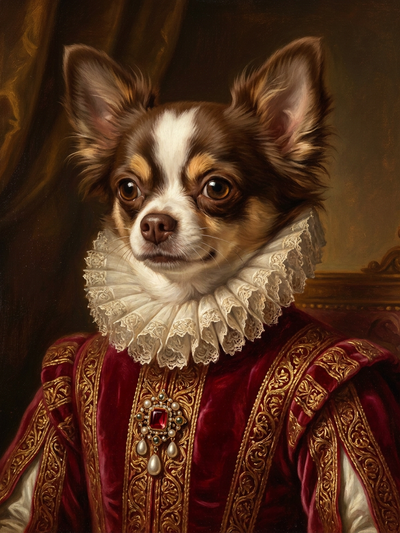
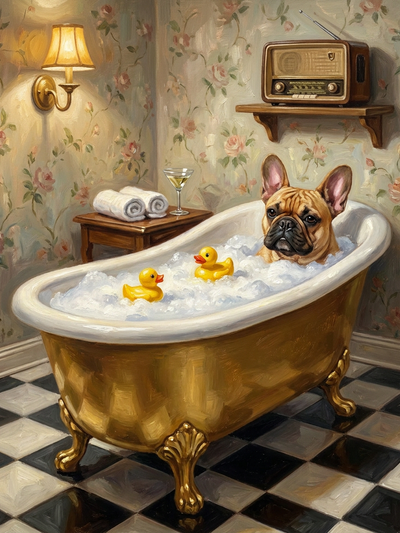
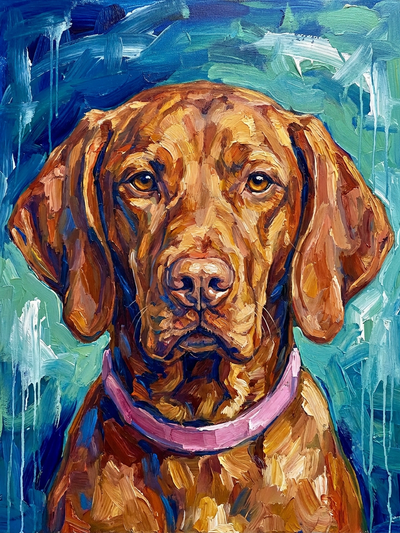
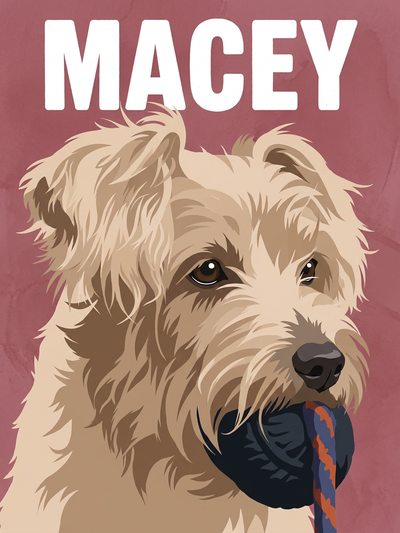
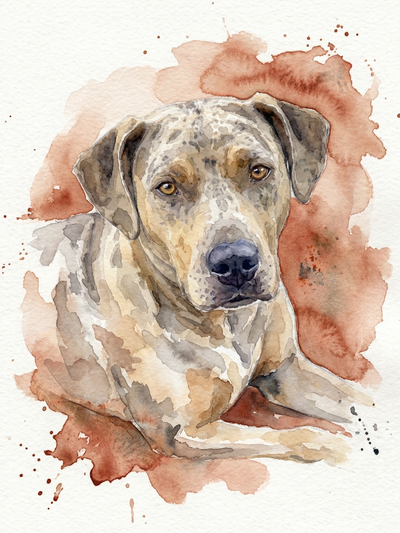
Whippets have a quality of physical elegance that portrait art has always found easy to work with. The long, fine-boned face, the deep chest, the tucked-up waist, the smooth coat that shows every line of the body beneath it — these are features that the portrait tradition, with its long history of rendering athletes and aristocrats, handles naturally. Whippets also have a gentleness of expression that contrasts interestingly with their athletic build, and it is this combination — the racing body and the soft, thoughtful face — that a portrait captures better than most other representations.
Coat colours and how they render
Whippets come in a wider range of colours than almost any other breed — virtually every colour and pattern that occurs in dogs is acceptable in the Whippet, including brindle, fawn, black, blue, white, cream and parti-colour in many combinations. This variety means the portrait results span a very wide aesthetic range.
Brindle Whippets — one of the most common colours — produce oil painting results of particular interest. The striped pattern in the short coat creates a surface of unusual complexity for such a smooth breed, and the oil painting style renders the subtle interplay of light and dark within the brindle with real depth.
Blue Whippets — the cool grey-blue dilute — suit watercolour and impressionist styles with the same cool atmospheric quality as other blue-toned breeds. The sleek coat picks up the ambient light around it, and the portrait reflects the environment as much as the dog.
Fawn Whippets have a warm honey tone that suits oil painting and renaissance particularly well. The clean, smooth coat in a warm fawn shows the elegant body structure clearly, and the portrait in these styles has a quality of classical athleticism.
White and parti-colour Whippets produce the most graphic results — the patches of colour on a white ground creating bold compositional structures in pop art and screen print styles.
Recommended styles for Whippets
Oil Painting — conveys the elegant body structure and handles brindle coats with depth. Watercolour — suits blue and cream Whippets particularly well. Renaissance — the classical athletic build suits the formal portrait tradition with real elegance. Sargent Portrait — the loose, confident brushwork of the Sargent style suits the Whippet's elegant bearing perfectly. Impressionist — the smooth coat picks up light and colour in ways that the impressionist style renders beautifully.
Photo tips
The Whippet's body structure is as much a part of the portrait as the face, and a photo that includes the full body — or at least the head, neck and chest — captures the breed more completely than a face-only shot. The smooth coat photographs well in natural light from the side, which picks out the muscle structure and the body's elegant lines. A standing or sitting pose shows the breed's proportions; the characteristic curled-up sleeping pose, while endearing, does not convey what makes the Whippet visually distinctive.