
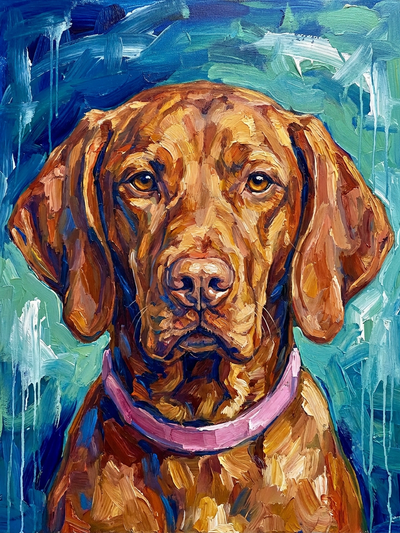
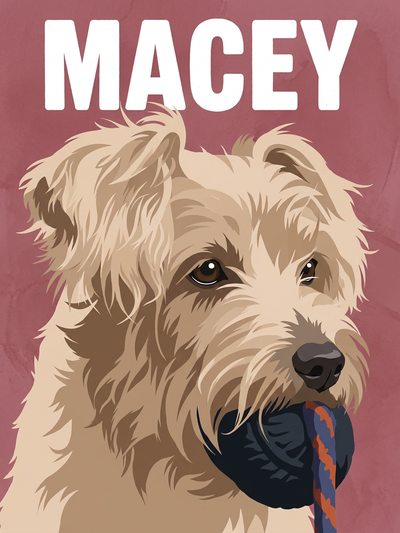
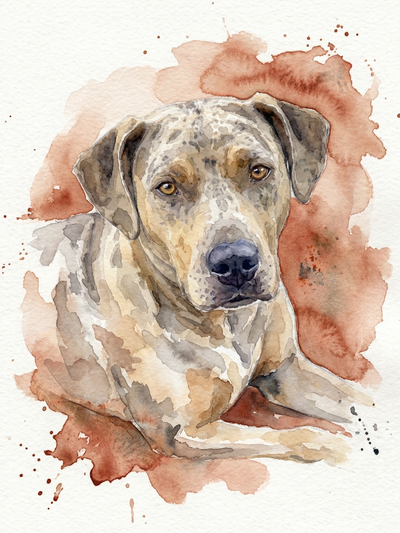
The Hungarian Vizsla is one of the oldest sporting dog breeds in the world, developed by the Magyar tribes of Hungary and refined over a thousand years into a dog of exceptional athletic elegance. The breed's appearance reflects this long history of deliberate development — the lean, muscular body, the short golden rust coat, the amber or dark golden eyes that match the coat in tone. A Vizsla portrait captures this quality of ancient, earned elegance in a way that the breed's working reputation sometimes overshadows.
Coat colours and how they render
The Hungarian Vizsla and the Wirehaired Vizsla share the same colour — golden rust, always — but differ in coat type. The smooth Vizsla has a short, dense, sleek coat. The Wirehaired Vizsla has a wiry, somewhat rougher coat of the same colour with a dense undercoat.
Smooth Vizslas produce the same portrait results as the related Vizsla covered elsewhere — the uniform golden rust creating portraits of warm harmony in oil painting, watercolour and impressionist styles. The lean, elegant body structure shows clearly through the short coat.
Wirehaired Vizslas have a coat texture that adds a different dimension to the portrait. The slightly rough, wiry quality of the coat in oil painting creates subtle surface interest beyond the smooth Vizsla's clean coat. In sketch style the textured coat translates into expressive, varied line work that suits the breed's rugged elegance.
Both varieties have the characteristic amber or dark golden eyes that create the portrait's focal point of warm colour unity — the eyes and the coat in the same warm register creating portraits of unusual harmonic warmth.
Recommended styles for Hungarian Vizslas
Oil Painting — the definitive choice for the warm golden rust in its richest expression. Watercolour — luminous and warm for both smooth and wirehaired varieties. Impressionist — finds the subtle tonal variation within the uniform warm coat. Renaissance — the breed's aristocratic Hungarian heritage suits the formal portrait tradition. Sargent Portrait — the loose, confident brushwork suits the breed's athletic elegance.
Photo tips
As with all uniformly warm-toned dogs, the source photo needs natural side light to create the tonal variation that gives the portrait its depth. Flat front light on a golden rust dog produces a portrait with less dimensionality than one where side light picks out the muscle structure and body lines. The amber eyes should be clearly lit — they are the portrait's warmest element and the source of its primary focal point. A photo that shows the lean, athletic body as well as the face gives the portrait the breed's defining physical quality.