
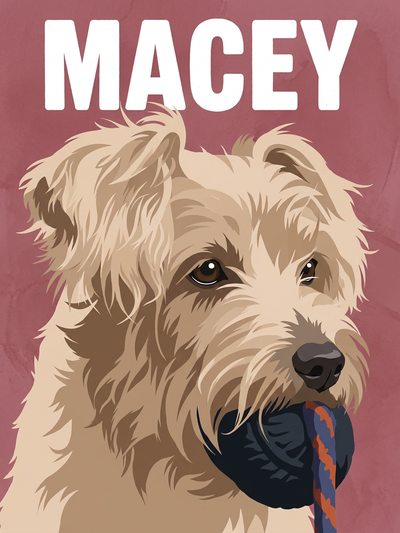
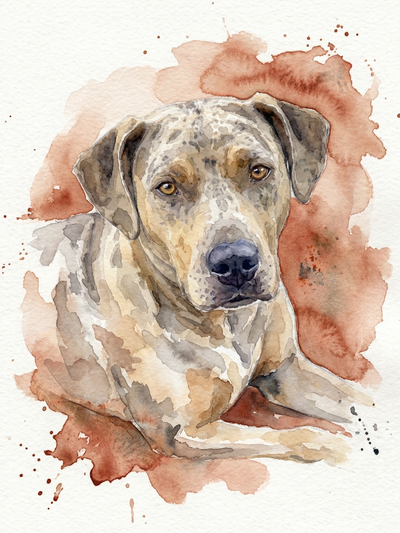
The Schnauzer — the standard variety, sitting between the Miniature and the Giant — has the same defining features as its relatives: the magnificent beard, the expressive eyebrows, the wiry coat and the expression of alert, slightly sceptical intelligence that the Schnauzer face carries naturally. The standard Schnauzer is the original from which the Miniature and Giant were both developed, and it has a completeness and balance of proportion that portrait styles respond to naturally. A Schnauzer portrait in almost any style has a quality of dignified character that is difficult to manufacture and easy to recognise.
Coat colours and how they render
Standard Schnauzers come in salt and pepper and solid black. The wiry, dense coat with its soft undercoat and the characteristic facial furnishings are consistent across both colours.
Salt and pepper Schnauzers — the more common colour — have the banded, mixed grey coat that gives painterly styles a complex surface to work with. The grey tones in the body coat, combined with the white or silver beard and eyebrows, create a portrait with a natural two-zone tonal structure. In oil painting the salt and pepper coat takes on a silvery warmth. In watercolour the mixed grey tones blend naturally into atmospheric tone.
Black Schnauzers produce the most formal portrait results. In Old Masters and oil painting the deep black wiry coat against a dark background creates a portrait of considerable presence — the beard and eyebrows catching the light and providing the portrait's brightening counterpoint to the dark coat.
Recommended styles for Schnauzers
Oil Painting — handles both coat colours with depth and suits the breed's dignified character. Old Masters — amplifies the formal quality of the black Schnauzer to its most distinguished expression. Sketch — the beard and eyebrows translate powerfully into expressive line work. Vintage — the breed's long European history suits the old-world warmth of this style. Renaissance — the distinguished bearing of the breed suits the formal portrait tradition.
Photo tips
The beard and eyebrows are the defining portrait features of the Schnauzer and must be clearly visible in the source photo. A photo where the beard is groomed, dry and not obscuring the face gives the portrait the best starting point. The eyebrows should be forward and expressive. Natural light from the front picks out the facial furnishings against the darker body coat. The wiry texture of the body coat shows best in natural light from a slight angle.