
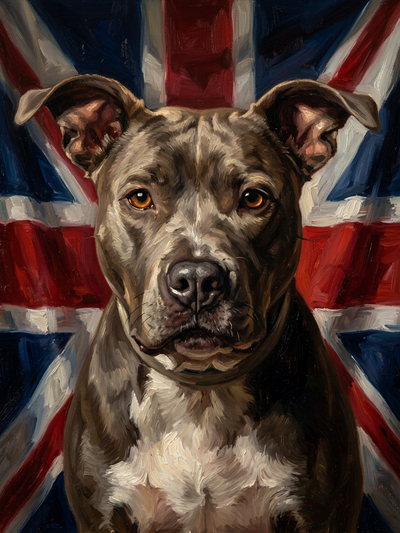
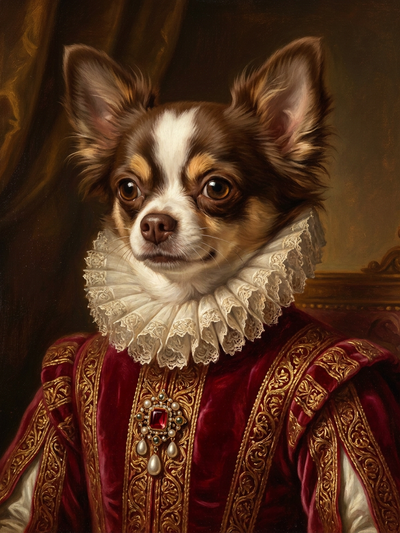
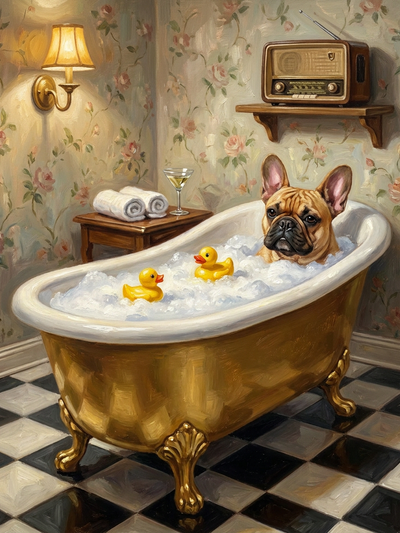
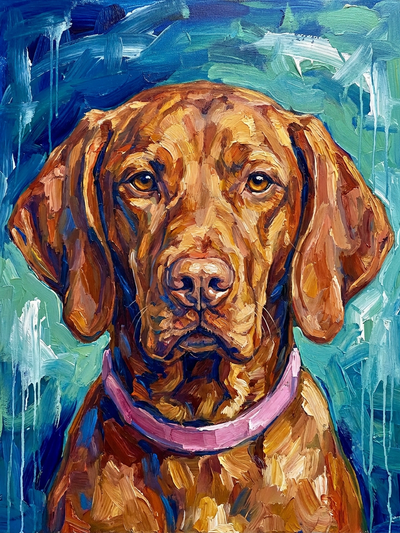
The Samoyed smile is not a figure of speech. The upturned corners of the mouth that give the breed its characteristic expression are a real anatomical feature — developed, according to one theory, to prevent drooling from freezing in the Arctic conditions the breed was bred for. Whatever the origin, the effect is a dog that appears to be smiling continuously, and this quality of apparent happiness combined with the spectacular white coat makes the Samoyed one of the most immediately engaging portrait subjects there is.
Coat colours and how they render
The Samoyed coat is always white or cream — a thick, double coat with a harsh outer layer and a dense, soft undercoat that gives the breed its characteristic cloud-like appearance. The coat stands away from the body rather than lying flat, giving it a three-dimensional volume that portrait styles find compelling.
In oil painting the white coat presents the full complexity that white coats always offer — the surface catching warm and cool reflections from the surrounding light, with the result never simply white but a surface of subtle tonal variation. The thick, standing coat has a volume that the oil painting style can suggest through tonal modelling rather than surface detail.
In watercolour the Samoyed coat requires restraint — the white ground of the paper is the white of the coat, and the painting is built from what surrounds and defines the coat rather than what is applied to it. When done well the result has a freshness and luminosity that heavier styles cannot achieve.
The volume and texture of the Samoyed coat gives impressionist style an exceptional amount to work with. The loose brushwork suggests the three-dimensional quality of the coat without trying to resolve every strand, and the result has a quality of softness and light that suits the breed's character.
Recommended styles for Samoyeds
Oil Painting — finds the tonal complexity within the apparently simple white coat. Watercolour — the luminosity of the medium suits the breed's white coat and bright character. Impressionist — handles the volume and texture of the thick coat exceptionally well. Botanical — the white coat against rich botanical colour creates striking visual contrast. Snow Fun Portrait — for the Samoyed in their natural element, this style is essentially built for them.
Photo tips
White coats require the same careful photography as all white dogs — natural light, no flash, attention to preventing overexposure. The Samoyed's thick coat adds a specific challenge: the volume of the coat can create deep shadows at the base of the fur that, in poor light, result in a portrait where the coat appears grey rather than white. Front-facing or slight above-front natural light gives the most even illumination across the coat's volume. Capturing the Samoyed smile — the upturned corners of the mouth — is worth the extra time it takes.