
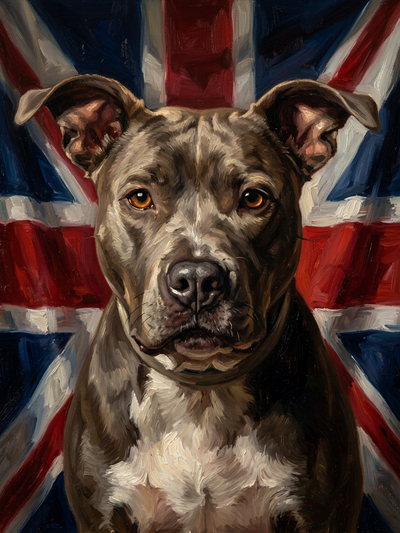
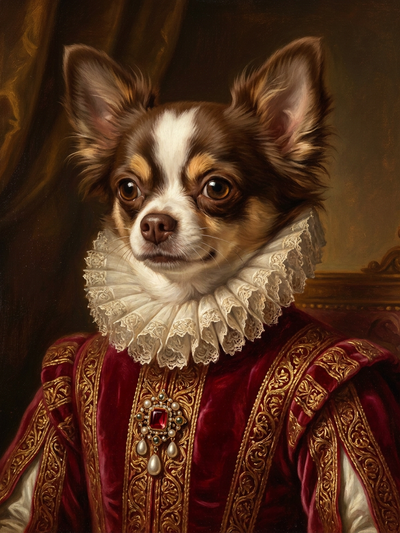
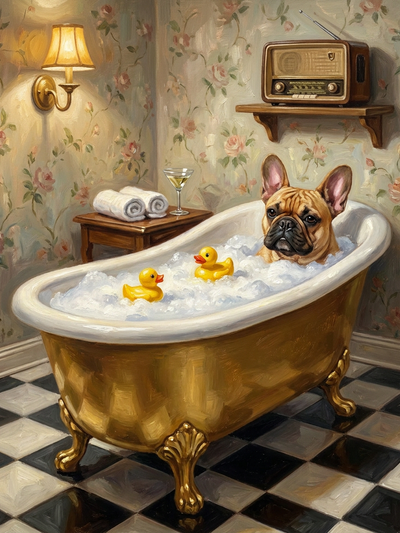
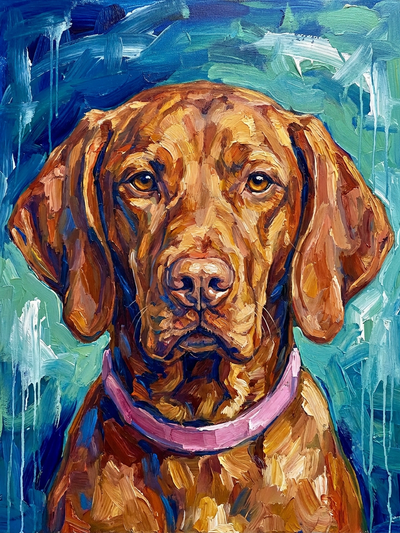
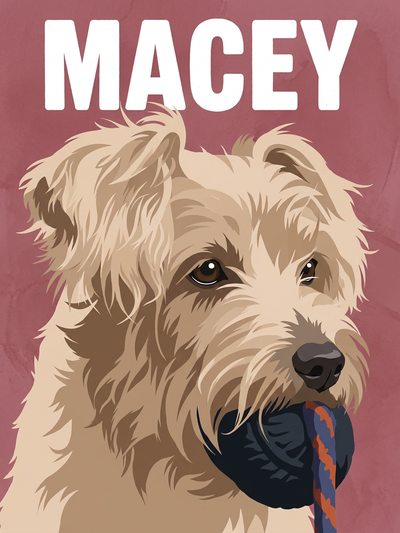
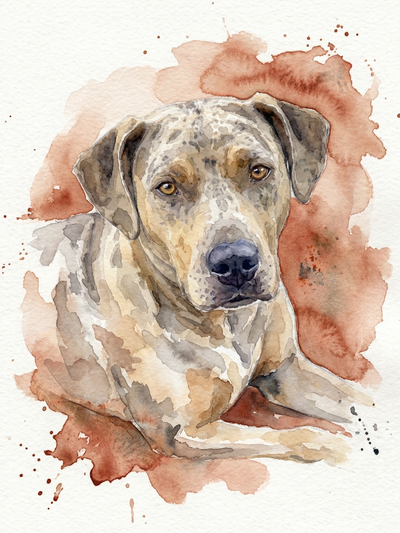
The Old English Sheepdog is one of the most immediately recognisable dogs in the world, and the reason is entirely the coat. The thick, shaggy double coat that covers the body completely — including, in many dogs, the eyes — creates a silhouette unlike any other breed's. There is something about the scale and the unruliness of the coat, and the lumbering, bear-like movement of the dog beneath it, that people find immediately endearing. Portrait styles that work with texture and volume find the Old English Sheepdog an extraordinarily rich subject.
Coat colours and how they render
Old English Sheepdogs are always grey or blue and white — the grey ranging from pale silver through to dark steel, often with a blue or blue merle quality in the outer coat. The coat is always long, dense and shaggy, with a soft undercoat and a harsh, textured outer layer.
Grey and white Sheepdogs — the most common colour pattern — produce oil painting results of exceptional textural richness. The shaggy coat has a surface complexity that the layered tonal approach of oil painting renders with real depth — each area of the coat picking up light and shadow differently depending on the direction and density of the fur.
Blue merle Sheepdogs have the additional complexity of the merle pattern within the grey coat — subtle mottling that watercolour handles with particular atmospheric quality.
The white markings — typically on the head, neck and forequarters — provide contrast against the grey body coat and give the portrait a natural compositional structure. The face, often partially or fully obscured by the coat, creates an interesting portrait challenge — a well-groomed dog with the face fur held back, or the characteristic parting that shows the eyes, produces the most expressive portrait results.
Recommended styles for Old English Sheepdogs
Oil Painting — the richest choice for the breed's exceptional coat texture. Impressionist — the shaggy coat's texture and volume suit the loose brushwork of this style naturally. Watercolour — particularly beautiful for lighter grey and blue merle coats. Sketch — the shaggy outline translates powerfully into expressive line work. Storybook — the Old English Sheepdog's association with children's literature and film suits this style with obvious charm.
Photo tips
The face is the most important element of the portrait and the most difficult to photograph in an Old English Sheepdog. If the coat covers the eyes, gently parting the face fur before taking the photo gives the portrait a subject it can build around. A photo where the eyes are visible and clearly lit produces a significantly better portrait than one where the face is entirely obscured by coat. The shaggy body coat benefits from natural light from the side, which picks out the texture and depth of the layers.