
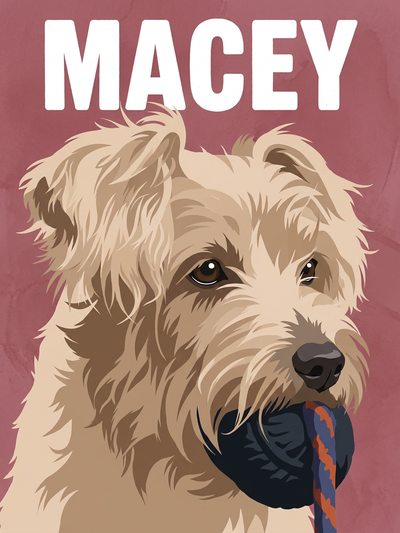
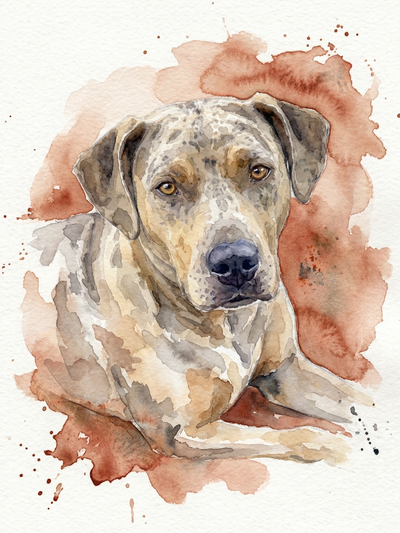
The Lhasa Apso was bred exclusively in Tibetan monasteries for over a thousand years and was considered sacred — the reincarnation of a lama who had not yet achieved Nirvana. The dogs were never sold but given as gifts, and leaving Tibet was not permitted until the Dalai Lama presented a pair to an American naturalist in 1933. The breed carries this extraordinary history in its bearing: the long flowing coat that parts naturally down the spine, the veil of hair over the face, the feathered tail curled over the back and the expression of ancient, self-possessed calm. A Lhasa Apso portrait is the continuation of a tradition of honouring this breed that stretches back more than a millennium.
Coat and colour
Lhasa Apsos come in a wide range of colours — golden, honey, dark grizzle, slate, smoke, parti-colour, black, white and brown among them. The coat is always the same: long, heavy, straight and hard, parting naturally down the spine and falling to the ground on either side.
Golden and honey Lhasa Apsos produce portrait results of warm elegance. The long, flowing coat in these warm tones suits oil painting and watercolour with a quality of ancient, quiet richness. The natural parting of the coat gives the portrait a compositional structure — the central parting directing the eye to the face through the surrounding coat.
Dark grizzle Lhasa Apsos — where the coat has a mix of dark and lighter tones — suit oil painting and impressionist styles. The mixed tones in the long, hard coat give the style's brushwork subtle colour variation to suggest.
White Lhasa Apsos suit watercolour and pastel with the luminous quality that white coats bring to these styles.
Black Lhasa Apsos produce the most formal portrait results — the long black coat flowing to the ground in oil painting and Old Masters creating portraits of unusual presence for a small dog.
Recommended styles for the Lhasa Apso
Oil painting is the richest choice for golden and dark-toned Lhasa Apsos. Watercolour — the flowing quality of the medium suits the flowing coat naturally. Renaissance pairs the monastery heritage with the formal portrait tradition. Ancient Egyptian — while Tibetan rather than Egyptian, the breed's ancient sacred status suits the style's ancient spiritual associations. Pastel is the softest and most delicate choice for lighter-coloured Lhasa Apsos.
Photo tips
The coat and the face must both be clearly visible in the source photo — the most common challenge with Lhasa Apsos is that the facial coat veil can obscure the face completely. Gently parting the face hair or using a clip to hold it clear of the eyes before taking the photo gives the portrait a subject it can build around. The natural parting of the coat along the spine is a distinctive feature worth showing if possible — a photo taken from above-front captures both the parting and the face. Natural light shows the coat's texture and the face equally.