
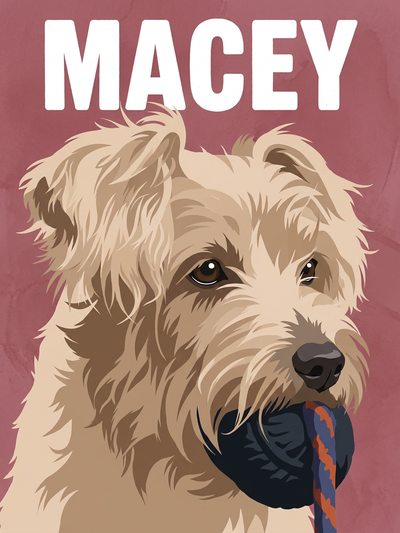
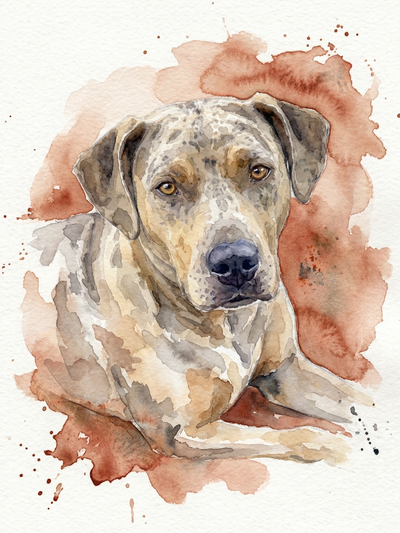
The Irish Wolfhound is the tallest dog breed in the world and one of the oldest. The breed appears in Irish mythology, was given as royal gifts between ancient kingdoms and was used to hunt wolves and elk across Ireland for centuries. By the nineteenth century the breed had nearly disappeared — the wolves were gone and the need for a dog that could hunt them had passed. The breed was restored from near-extinction and the modern Irish Wolfhound carries that history of near-loss and survival in its bearing — a dog of great size and great gentleness, whose scale makes every portrait an event.
Coat and colour
Irish Wolfhounds come in grey, brindle, red, black, white and fawn. The coat is always rough and wiry with a dense undercoat — the rough outer coat giving the breed a slightly shaggy, weathered appearance that suits portrait styles working with texture.
Grey Irish Wolfhounds — the most common colour — produce portrait results of atmospheric depth. The rough grey coat in oil painting and Old Masters has a quality of formal presence that suits the breed's ancient associations. The texture of the wiry coat gives these styles a complex surface to work with.
Brindle Irish Wolfhounds have the striped pattern within the rough coat — a subtle combination that oil painting renders with tonal interest. The brindle stripes visible through the wiry texture create a coat of unusual depth.
Red Irish Wolfhounds — where the coat is a warm reddish-fawn — suit oil painting and watercolour with their warm palette. The warmth of the red coat in the painting tradition creates portraits of great richness for such a large, grey-associated breed.
Fawn and white Irish Wolfhounds suit watercolour and pastel styles with the softest, most delicate colour in the breed range.
Recommended styles for the Irish Wolfhound
Oil painting is the traditional choice for a breed with ancient associations. Old Masters suits the scale and ancient heritage in the most formal tradition. Renaissance pairs Celtic nobility with the formal portrait tradition. Watercolour is particularly beautiful for red and fawn Irish Wolfhounds. Camelot — the breed's medieval Irish associations suit the style's medieval setting.
Photo tips
The scale of the Irish Wolfhound creates significant photographic challenges. Getting to eye level with a dog that can stand over 80cm at the shoulder requires real effort — but a photo from the dog's eye level rather than from above is worth it for the portrait quality. The rough, wiry coat benefits from natural light from the side that picks out the texture. A standing pose is important for capturing the breed's scale — the Irish Wolfhound's height is part of what makes the portrait impressive and a sitting or lying pose underrepresents it.