
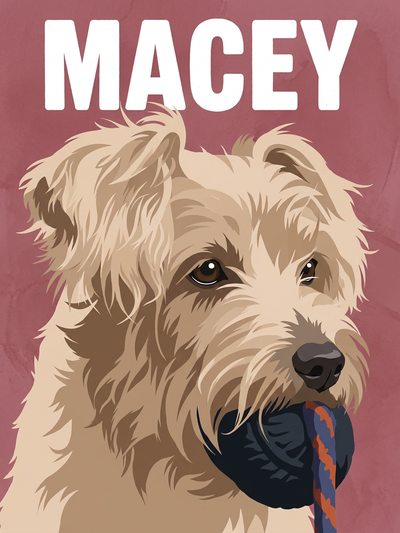
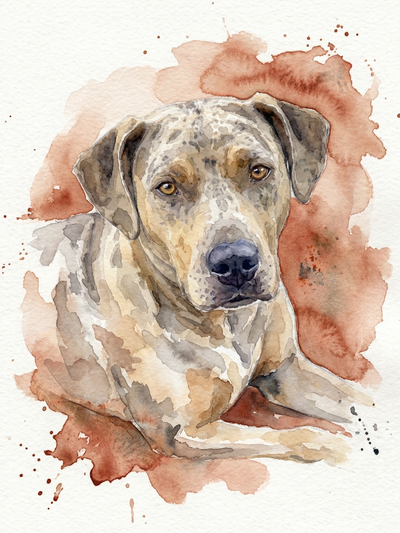
Greyhounds have one of the most recognisable and most painted profiles in the history of dog portraiture. From ancient Egyptian art through to the formal paintings of the English country house tradition, the Greyhound's long narrow skull, the elegant neck and the deep chest have appeared in human visual culture for thousands of years. The breed has been painted by more serious artists than almost any other, and the reason is always the same: the profile is simply one of the most visually satisfying shapes in the natural world. A Greyhound portrait is not an unusual idea. It is a very old one.
Coat colours and how they render
Greyhounds come in a wide range of colours — brindle, fawn, black, blue, white, red and parti-colour among them. The coat is always short, smooth and fine, which means the body structure reads clearly through it and the portrait result depends on the quality of the source photo's lighting as much as the colour.
Brindle Greyhounds produce oil painting results of particular interest. The striped pattern in the smooth coat creates subtle visual complexity — the stripes visible at close range but the overall impression at distance being a more unified colour.
Fawn Greyhounds have a warm honey tone that suits renaissance and oil painting naturally. The elegant profile in a warm fawn, in oils or renaissance style, creates portraits with a quality of classical nobility.
Blue Greyhounds — the cool grey — suit watercolour and impressionist styles. The sleek smooth coat picks up the ambient light and the portrait reflects that atmospheric quality.
Black Greyhounds produce striking Old Masters results. The deep even coat against a dark background creates a portrait of great drama — the long profile and the deep chest emerging from darkness in warm highlights.
Recommended styles for Greyhounds
Oil Painting — the traditional choice for a breed with a long portrait history. Renaissance — the breed's ancient noble associations make the formal tradition an obvious fit. Old Masters — particularly striking for black Greyhounds. Sargent Portrait — the loose elegant brushwork suits the Greyhound's bearing. Watercolour — suits the lighter-coloured and blue Greyhounds with atmospheric quality.
Photo tips
The Greyhound profile is the most distinctive portrait angle for the breed — a photo taken from the side showing the full length of the narrow skull, the long neck and the deep chest captures what makes Greyhounds visually unique. Frontal photos of Greyhounds can flatten the narrow head in ways that lose the breed's most distinctive feature. The smooth coat is best captured in natural side light, which picks out the body structure without creating harsh shadows on the fine coat.