
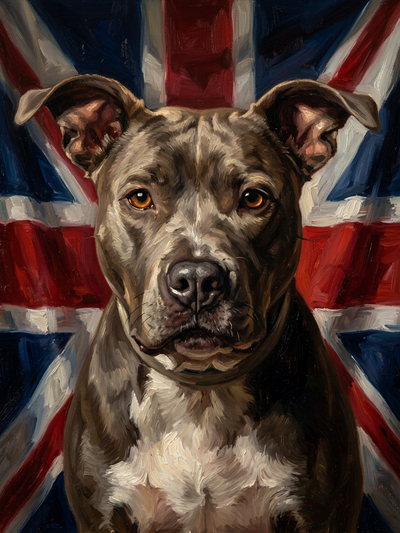
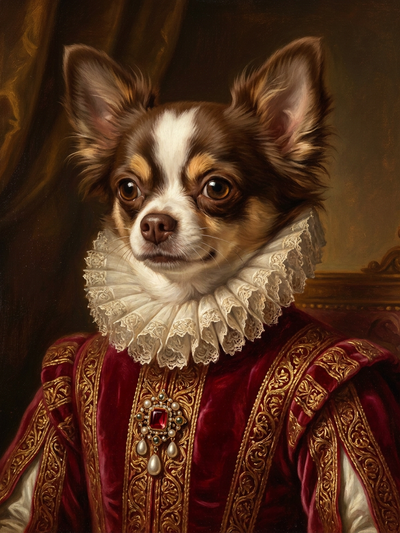
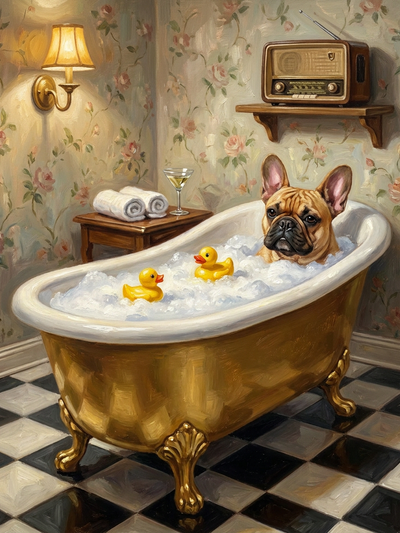
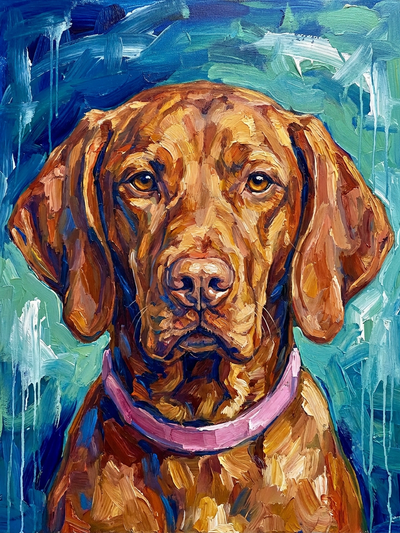
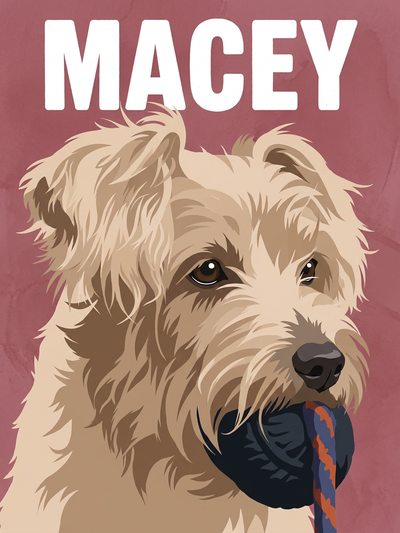
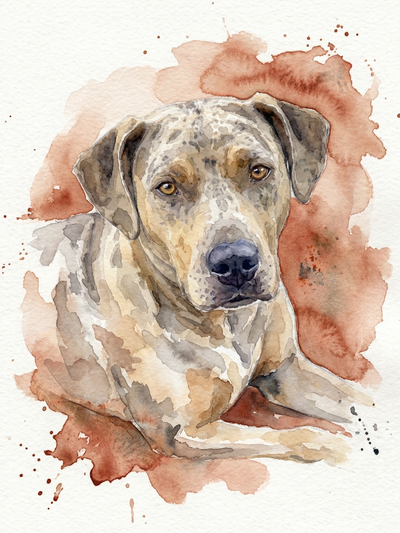
Boxers have a face that is simultaneously serious and comic — the furrowed brow suggests gravitas, the underbite suggests something else entirely, and the combination produces an expression that is entirely their own. This particular quality of expression — earnest, direct, slightly confused but absolutely committed — is one of the most engaging in the dog world, and it translates into portrait art with unusual success. A Boxer portrait captures something that photographs only half-manage: the particular concentrated attention the breed brings to everything it does.
Coat colours and how they render
Boxers come in fawn, brindle and white, with most having white markings on the face and chest. Fawn Boxers — ranging from pale yellow-fawn to deep mahogany — produce the warmest portrait results. In oil painting the fawn coat takes on a rich amber tone and the white flash on the face provides a natural focal point. The black mask, present in most fawn Boxers, gives the portrait a strong tonal structure.
Brindle Boxers have a coat complexity that oil painting handles with particular interest. The dark stripes through a fawn base catch light at different angles, and the overall effect in an oil painting portrait is a coat of unusual depth and visual richness.
White Boxers — where the white covers most or all of the body — produce striking results in styles with strong tonal contrast. In pop art the bold graphic quality of a largely white dog against a strong background colour creates an immediately eye-catching portrait.
Recommended styles for Boxers
Oil painting is the strongest choice for fawn and brindle Boxers. Renaissance suits the noble structure of the Boxer face within the formal portrait tradition. Pop art works particularly well for white Boxers. Cinematic suits the athletic build and intense expression. Old Masters is reserved for the Boxer whose expression carries the weight of centuries.
Photo tips
The Boxer's underbite is part of what makes the breed's expression so distinctive — a portrait that captures it accurately rather than smoothing it over produces a more characterful result. A photo taken at or slightly below eye level, with the dog looking directly forward, shows the structure of the face most clearly. The wrinkled brow is best captured in natural light from above-front, which picks out the furrow structure without creating overly deep shadows.