
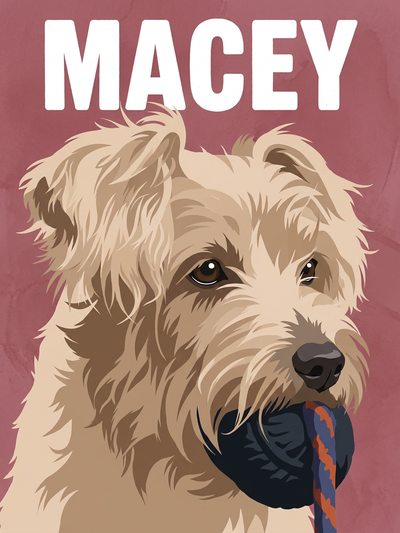
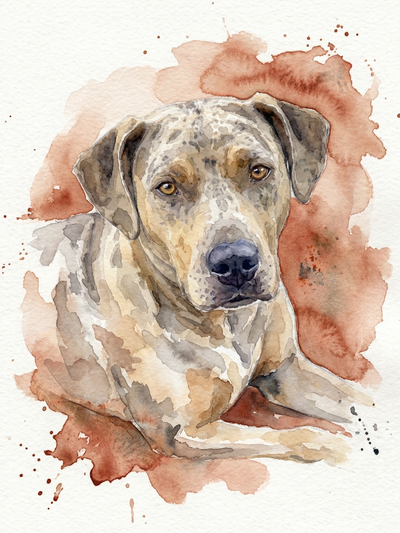
The Borzoi — the Russian wolfhound — was bred for centuries exclusively by Russian aristocracy and was a favourite subject of court painters. The breed's appearance justifies the attention: the impossibly long, narrow head, the deep chest, the arched back and the long, silky coat that flows behind the dog in movement create a silhouette of extraordinary elegance. Tolstoy described Borzoi hunts in War and Peace with the same reverence he gave to battles. The breed has always occupied a space where beauty and purpose coexist with unusual grace, and portrait art finds this combination irresistible.
Coat and colour
Borzois come in virtually every colour and pattern — white, golden, cream, brindle, black, sable and parti-colour being among the most common — in a long, silky coat that is wavy or slightly curly and particularly profuse on the neck, chest and tail.
White and cream Borzois produce portrait results of extraordinary elegance. The long silky coat in these pale tones in watercolour has a luminous delicacy that suits the breed's aristocratic character. In oil painting the white coat picks up the warm and cool tones of the painting tradition, creating a portrait of subtle, shifting tonal complexity.
Golden and sable Borzois suit oil painting and impressionist styles. The long flowing coat in warm golden tones in the painting tradition has a richness and movement that places the breed in the great tradition of aristocratic dog portraiture.
Brindle Borzois — the striped pattern within the long silky coat — produce portrait results of unusual visual interest. The brindle stripes visible through the flowing coat give oil painting and impressionist styles a complex, moving surface to interpret.
Black Borzois in Old Masters and renaissance produce portraits of great dramatic presence — the long narrow head emerging from the dark coat with a quality of formal intensity.
Recommended styles for the Borzoi
Oil painting is the traditional choice for a breed with a deep portrait history. Watercolour is particularly beautiful for white and cream Borzois. Impressionist suits the flowing long coat in movement and its loose brushwork. Renaissance suits the aristocratic Russian heritage and the formal portrait tradition. Pre-Raphaelite and the silky flowing coat are a natural combination.
Photo tips
The extraordinarily long, narrow head is the defining portrait feature of the Borzoi and should be shown from a slight three-quarter angle that reveals its full length. A full-face front-on photo loses the most distinctive feature of the breed. The flowing coat should be shown at its fullest — a photo taken outdoors where the coat falls naturally gives the portrait the most to work with. Natural light from the side picks out the silky coat texture most clearly. Include the neck and chest to show the coat's flowing quality around the breed's elegant frame.